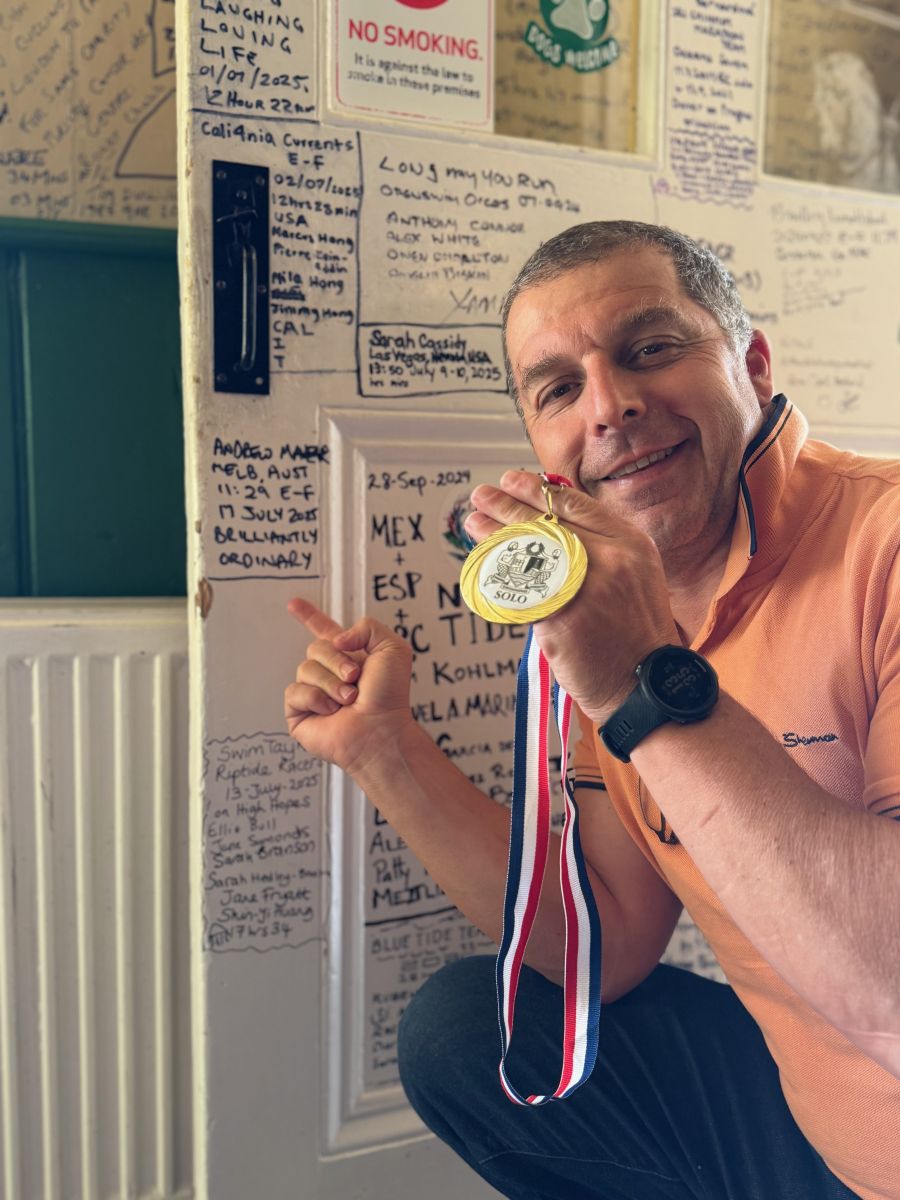
Across the English Channel: Andrew Maver’s 49-km leap of faith
What does it take to swim from England to France? For 55-year-old Andrew Maver, it’s got nothing to do with bravado or bucket lists. It’s sparked by a need for a challenge and supported by a lifelong love of water. We caught up with Andrew to unpack everything that went into his recent trip across the channel: endurance, doubt, jellyfish… and what really carries you across 49 km of open sea.
A childhood measured in laps
The question of whether Andrew has gills dates back to his childhood.
‘Our grandparents had a pool in their backyard,’ he says. ‘My earliest and fondest memories are spending summers in that pool. The water has always been my happy place.
‘I think I could actually swim before I could walk,’ he laughs.
By 13, that early love had turned competitive. ‘I went from just starting out to state champion in the space of about 18 months,’ Andrew recalls. ‘I didn’t have a lot of speed, but I had this capacity for endurance swimming.’
Still, the grind took its toll.
‘It’s very demanding, mentally and physically,’ he says. ‘So, after school, I took a break from swimming altogether.’
To be exact, it was nearly two decades before Andrew returned to the sport. But this time, racing wasn’t on his mind.
‘I didn’t want to be competitive; I just wanted to swim.’
The idea that waited 20 years
Andrew wouldn’t call the idea of swimming the English Channel a whim, per se. But there was a certain moment that brought the idea back to life.
‘I was clearing out our office and found a file dated 2003 called English Channel Research,’ he says. ‘So the idea has been there for at least 20 years.’
But the timing just never felt right. Until it did.
‘In late October 2024, I needed a challenge. Something outside of work. Looking back, I feel like I was just going through the motions,’ Andrew says. ‘I mentioned that to someone at the pool who had swum the English Channel a few years ago, and he knew someone who might have a last-minute window – just eight months away.’
His family was equal parts supportive and sceptical.
‘It’s not uncommon for me to do something a little out of the norm,’ Andrew explains. Which, of course, is an understatement. He did the 19.7 km Rottnest Channel swim solo in 2017.
‘My family is incredibly supportive, but they also think I’m a bit mad,’ he jokes.
Eight months to build a body (and a brain)
Andrew wasn’t given much time to prepare for one of the world’s toughest swims.
‘My first month of training was really just about showing up,’ he says simply. ‘Three mornings a week at 5.30 am and a longer swim on Saturdays.’
His first 5 km session was sobering. ‘I thought I was going to die,’ he laughs.
The Channel is roughly 35 km as the crow flies. With tides, it can be much, much longer. How am I ever going to do this? he remembers thinking.
It made things easier that he trained with people who had done it. ‘I trained with John Van Wisse, who coached me. He’s done multiple crossings, including a double, so I couldn’t have had a better person guiding me.’
Andrew’s long swims crept up: 10 km. Then 12, 14, 15. ‘Some days in the pool, some in open water. But if I was a few hundred metres short, it wasn’t the end of the world. I just tried harder the next time.’
And it was just as much about mentality as it was physicality.
‘You’ve got to get comfortable with being physically tired,’ Andrew summarises. ‘And you need to be tough enough to keep going despite it.’
Touching English soil
Flying into London made it real.
‘We were flying over the Channel and took a photo of the flight display,’ Andrew says. ‘I remember thinking how easy it was to cross from the sky.’
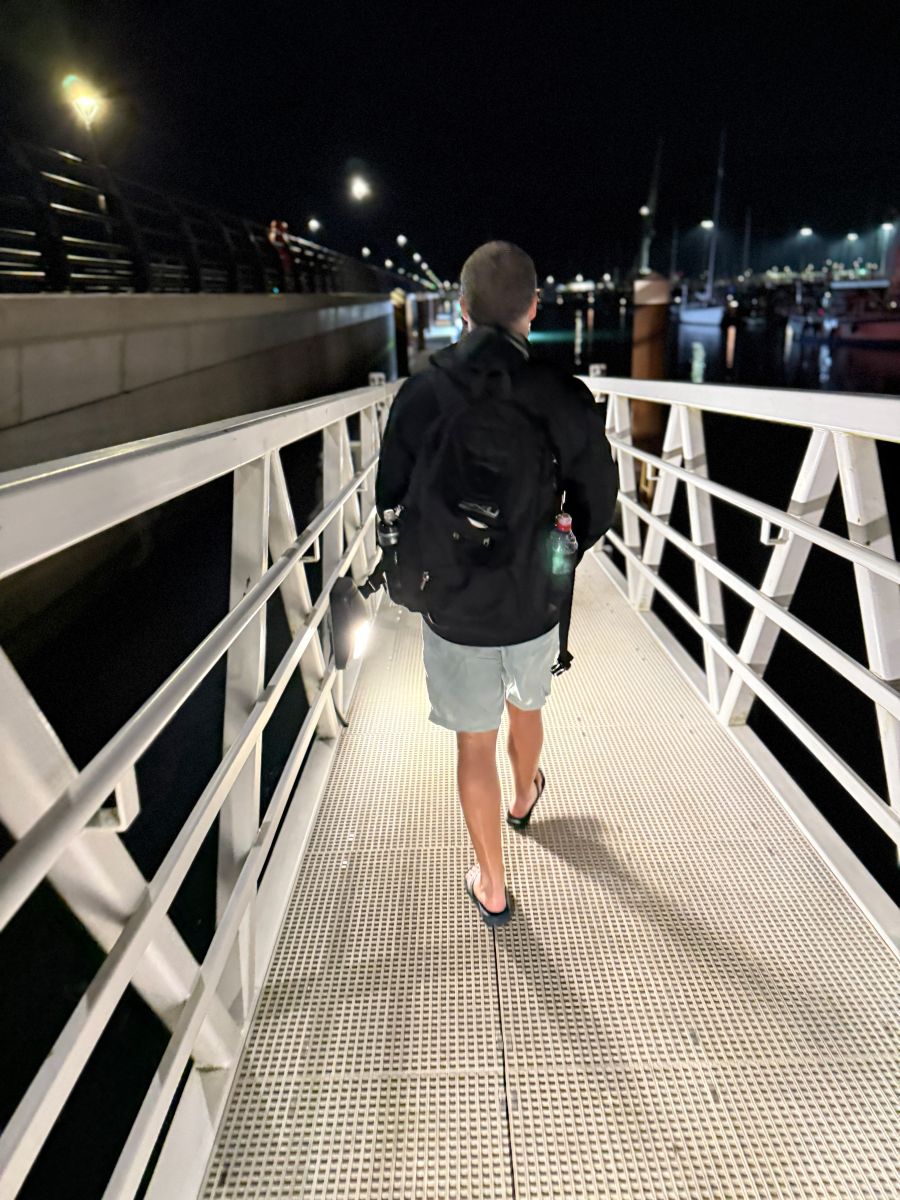
The swim began at 4 am. ‘But I wasn’t nervous,’ Andrew remembers. ‘At that point, I just wanted to get it done.’
At the beach, protocol ruled. The boat stopped 300 m offshore before the swim officially began.
‘You jump off, swim to English soil, walk out of the water, then someone blows a horn, and you walk back in. That’s when it starts.’
That moment – walking back into the dark water – was stark.
‘You go, there is absolutely no turning back now. The next time I hit land will be in France.’
Eleven and a half hours in open water
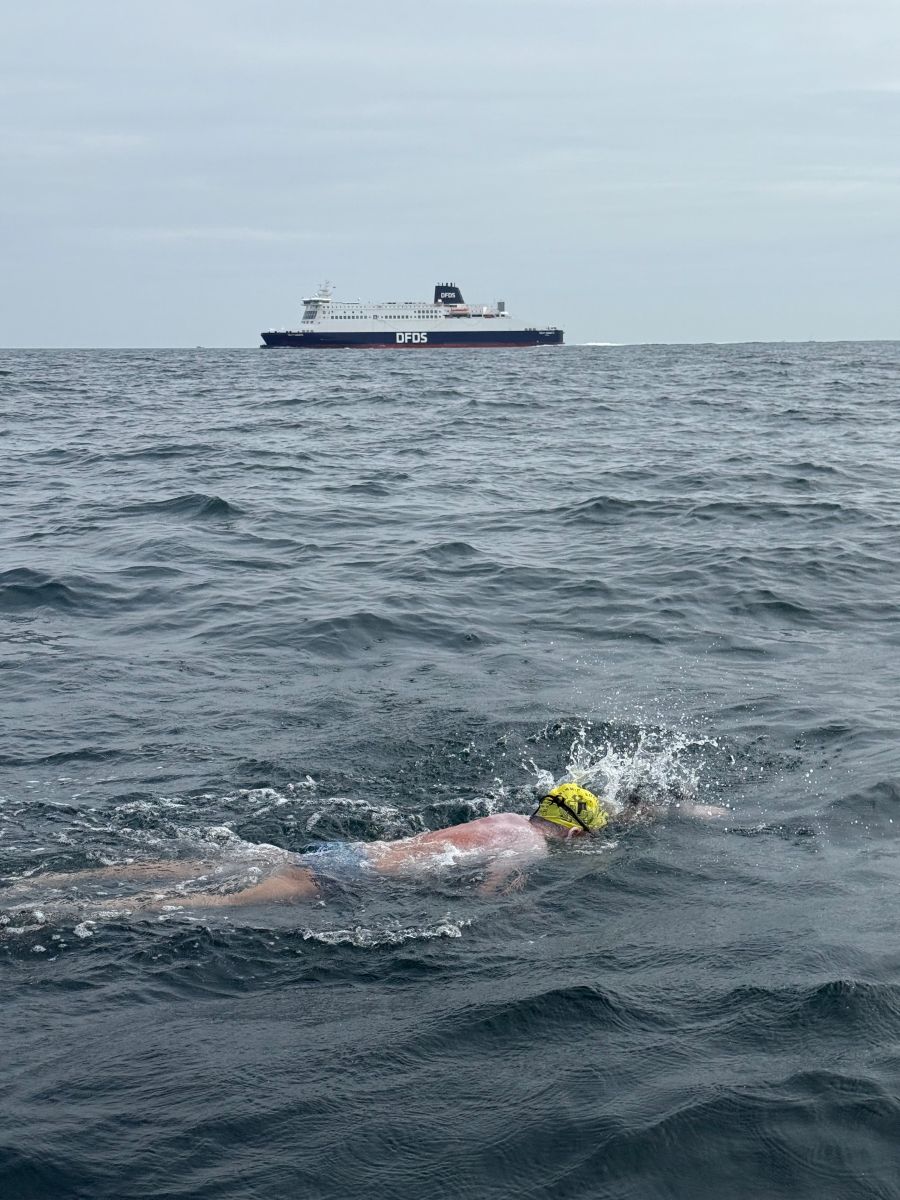
The first hour of the swim was about rhythm.
‘I was just trying to focus on finding a groove and not going too fast,’ Andrew shares. But then came the jellyfish…
‘I got stung twice in the first hour,’ he exclaims. From there, for hours, he played dodge-the-jellyfish. ‘Visibility was maybe two or three metres, so you’ve only got seconds to react when a jellyfish does, inevitably, pop up.’
But, funnily enough, the jellyfish ended up being a welcome distraction. ‘It actually takes your mind off what you’re doing!’
Food came every 30 minutes. Conditions changed. Diesel fumes from the escort boat clogged his nose. And yet, Andrew swam.
‘I spent a lot of time thinking about my aunt, who was in hospital in excruciating pain,’ Andrew shares. ‘I kept thinking to myself that I was lucky to only be in temporary pain by comparison.’
Then came the hardest part: seeing France. ‘When you see land, you think you’re there, but you’re not. I was less than a kilometre from shore for at least an hour and a half.’
That’s because that pesky tide forced him sideways. As a result, Andrew’s swim ended up being 49 km – and 11.5 hours – long.
Regaining your land legs
Eventually, after so long of swimming parallel to the shore, Andrew finally got the ‘all clear’ to head inland.
‘There’s a moment when you can see the sand on the bottom,’ he says. ‘That’s when you go, I’ve actually done it.’
He stood carefully. ‘They tell you to make sure you’re stable,’ he says. ‘You’ve been horizontal for 10, 12 hours. The last thing you want is to fall over.’
And then, relief. ‘Euphoria. It was a massive sense of accomplishment.’ He sat down. Took it in. ‘I wanted to imprint that moment like a photograph.’
But there’s one thing Andrew said he would change if he could.
‘My partner, Alison, endured the whole journey just as much as I did, but she was still out on the boat when I hit land. I wish she could have been with me on the beach to share the moment when I finally stood up.’
Soon enough though, Andrew turned around and headed back towards Alison and the boat – where reality inevitably hit.
‘I threw up a couple of times, and then promptly fell asleep until we ended up back in Dover.’
What stays with you
Andrew was the 302nd Australian to complete the crossing.
‘There’s been more Australians who’ve won Olympic gold than crossed the Channel,’ he says. He’s proud, obviously, but grounded. ‘That said, I know a dozen people who’ve done it. So, I guess it depends on how you look at it.’
The body takes a lot longer to recover than the ego.
‘There’s this deep-seated fatigue that doesn’t kick in for four to six weeks.’ And, by all accounts, it’s humbling. ‘You go from being incredibly fit to thinking, I can’t even swim a kilometre anymore.’
But that integral drive, the thing that pushed him towards a challenge of this magnitude in the first place? That hasn’t gone anywhere.
‘I’ve been thinking about the other Ocean Seven swims, but we’ll have to wait and see if the stars align on that.’
For now, Andrew is content adding this stretch of open water to his swimming cap. And getting back in the pool to conquer that once again elusive kilometre.